Extended view totally extraperitoneal (eTEP) repair - a cutting-edge approach for complex abdominal wall hernias requiring durable muscle reconstruction.
eTEP stands for extended view Totally Extraperitoneal repair. It is an advanced surgical development that adapts the classic, highly successful open **Rives-Stoppa** retrorectus repair for modern laparoscopic and robotic platforms.
By accessing the retrorectus space (the natural pocket located behind the rectus abdominis or "six-pack" muscles), the surgeon creates a spacious extraperitoneal working environment. This allows large defects in the abdominal wall to be closed and reinforced with mesh, while avoiding entering the peritoneal cavity containing internal organs.
eTEP represents a major leap in abdominal wall reconstruction. It brings the robust, time-tested principles of posterior sublay mesh placement to a minimally invasive keyhole platform, enabling surgeons to treat complex hernias that previously required massive, painful open scars.
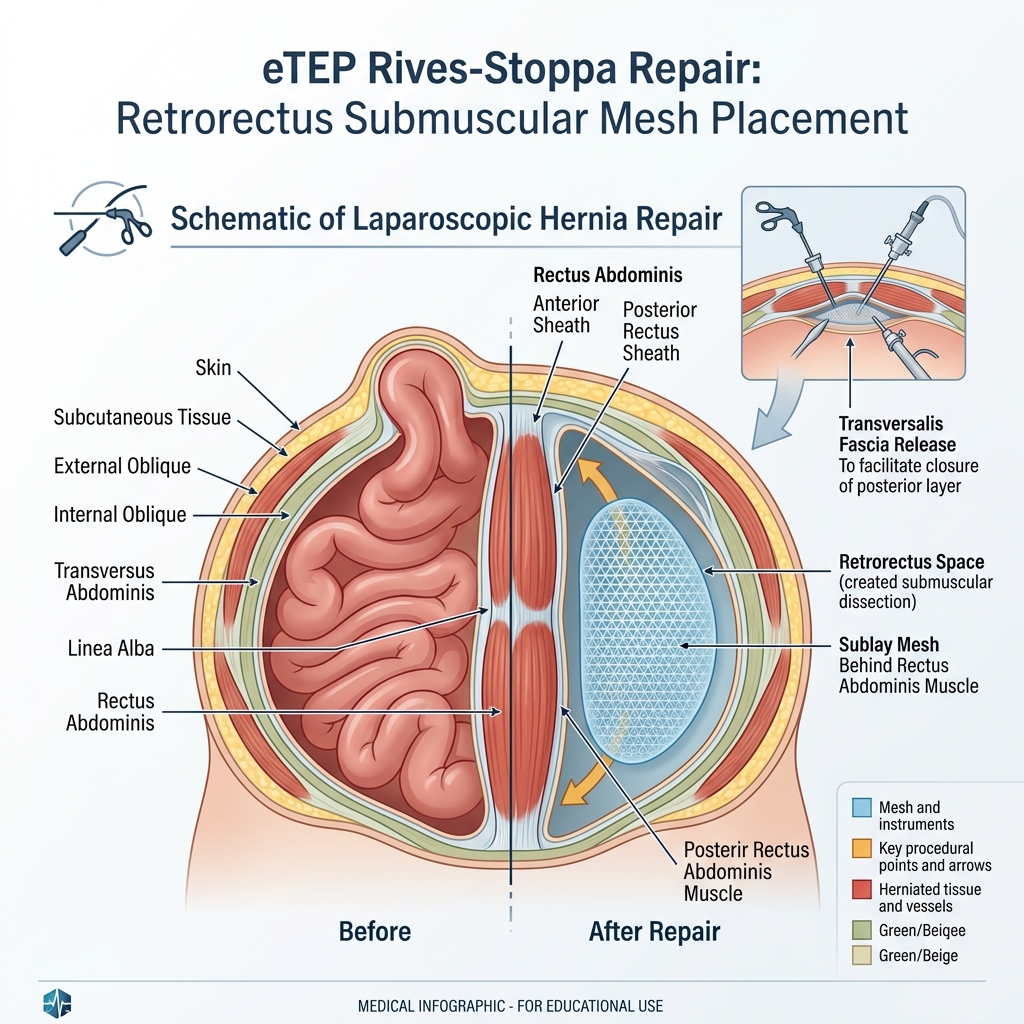
Retrorectus Positioning
Places mesh behind the six-pack muscles
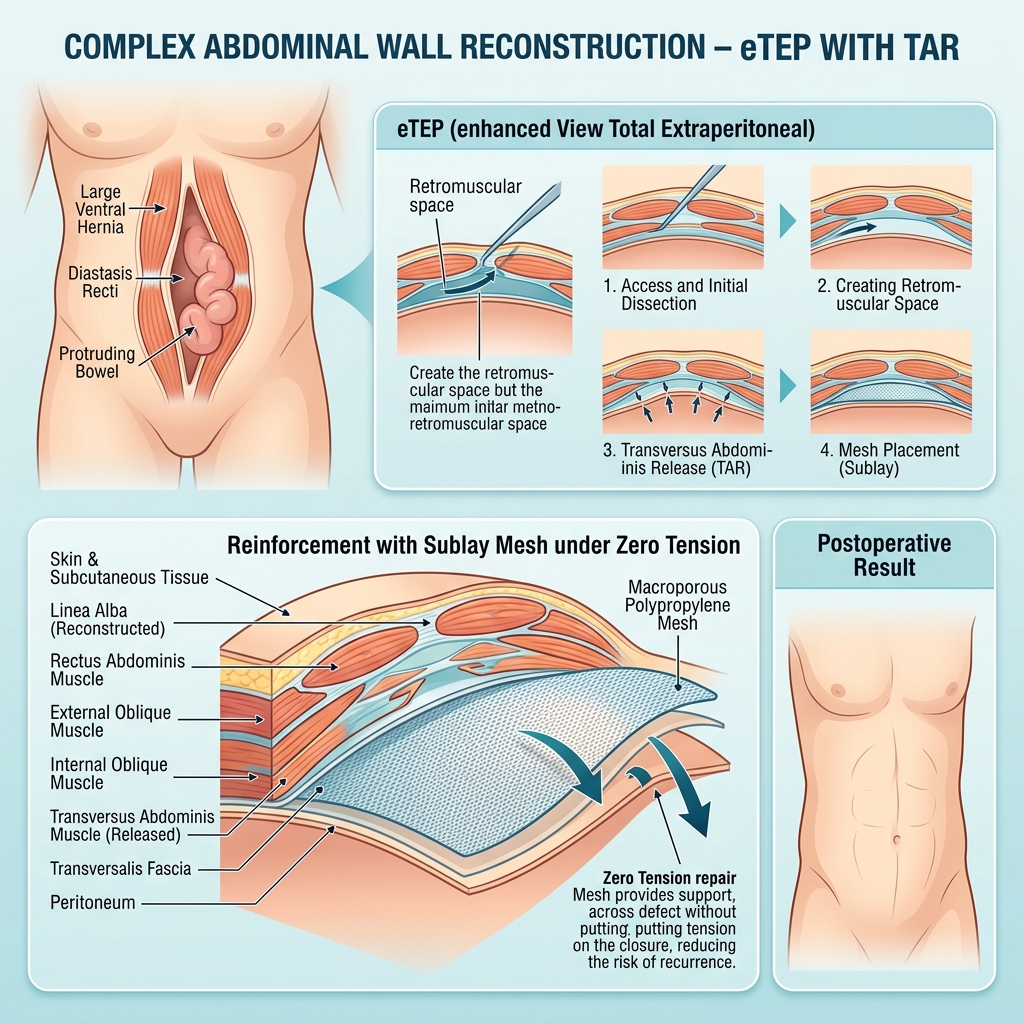
eTEP is highly useful for patients with large, multiple, or recurrent hernias, bridging the gap between keyhole simplicity and massive reconstructive durability.
Sublay Submuscular Substrate
Maximum stability behind rectus muscles
Ventral defects with wide muscle gaps that require large, secure mesh borders and comprehensive abdominal wall restoration.
Hernias that have recurred after previous suture or mesh attempts, surrounded by deep scarring and anatomical changes.
Abdominal defects that have formed along previous surgical scars due to underlying tissue weakness.
Patients displaying multiple concurrent defects (such as an umbilical hernia and a groin hernia) needing simultaneous repair.
Detects hidden lateral weaknesses on initial view, reinforcing them to prevent future hernia formations.
Previous sub-optimal mesh applications that have migrated or curled, requiring safe extraction and a larger retrorectus sublay mesh placement.
For extremely large abdominal wall hernias, eTEP can be combined with a **TAR (Transversus Abdominis Release)**. By releasing a specific muscle layer on the sides of the abdomen, the surgeon can advance the central muscles significantly, closing huge gaps without structural tension, and laying a massive reinforcing mesh underneath.
Placing a large mesh in the retrorectus plane behind the rectus muscles leverages the patient's own tissue weight to hold the repair in place permanently.
Replaces giant 20–30 cm incisions with a few tiny port entries. This preserves cosmetic results, lowers infection rates, and shortens healing.
Keeping the mesh outside the peritoneal cavity isolates it completely from the bowels and stomach, eliminating bowel stickiness or chronic pain.
For decades, the open sublay retrorectus mesh placement (Rives-Stoppa) has been recognized as the most durable abdominal wall repair possible, boasting recurrence rates near zero. However, it required large incisions that caused substantial post-op pain and prolonged recovery.
eTEP delivers this exact robust structural outcome using a few tiny port entries. By reinforcing the defect from behind the muscle, the repair is protected by the patient's own muscular tissues, providing high long-term strength.
eTEP is technically demanding and requires advanced, specialized training. Dr. Kumar has extensive experience in complex abdominal wall reconstruction.
Because eTEP is used for complex abdominal reconstructions, recovery is longer than standard keyholes, but still significantly faster and less painful than traditional open surgery.
Typically requires 1 to 3 days in the hospital for pain monitoring, early mobilization, and active bowel function checks.
Recover comfortably at home. Walk around regularly. Pain levels subside dramatically as ports heal.
Return to office-based light duties. Abdominal wall strength is rebuilding. Maintain binder usage.
The sublay mesh is completely incorporated. Strenuous sports, gym training, and heavy lifting can be resumed.
eTEP stands for extended view Totally Extraperitoneal repair. The surgeon enters the retrorectus space (behind the abdominal muscles but in front of the peritoneum lining) using three small keyholes, creates a spacious extraperitoneal workspace, closes the abdominal wall defect, and deploys a large reinforcing mesh without ever entering the abdominal organ cavity.
Dr. Kumar specializes in advanced hernia reconstruction including eTEP. If you've been told your hernia is too complex, schedule an expert evaluation.
+91 89255 02759
Tap to call