Abdominal Restoration

Diastasis Recti
(Divarication of Recti)

Dr. Kumar offers Comprehensive recovery for abdominal muscle separation and expert treatment (Diastasis of Recti). Divarication of Recti Correction in Chennai. Restore your core support, relieve persistent back pain, and regain abdominal wall function.

Core Definition

What is Diastasis Recti?

Diastasis Recti (also known as divarication of the rectus abdominis muscles) is the separation of the left and right sides of the "six-pack" muscle. The separation occurs at the midline fascia, the linea alba, which stretches and becomes thin.

Unlike a ventral or umbilical hernia, Diastasis Recti is not a true hernia—there is no physical tear or hole in the abdominal wall, meaning there is no risk of organ entrapment (incarceration). However, because the central support tissue is stretched out, internal organs bulge forward, creating a ridge or "pooch" down the center of the abdomen.

Common Causes of Divarication

  • Pregnancy: Rapid expansion of the uterus combined with pregnancy hormones (relaxin) that soften connective tissues.
  • Weight Fluctuations: Excess visceral fat placing constant internal pressure on the midline.
  • Improper Lifting: Repeated heavy lifting using poor mechanics that increase intra-abdominal pressure.

Diastasis Recti Classification
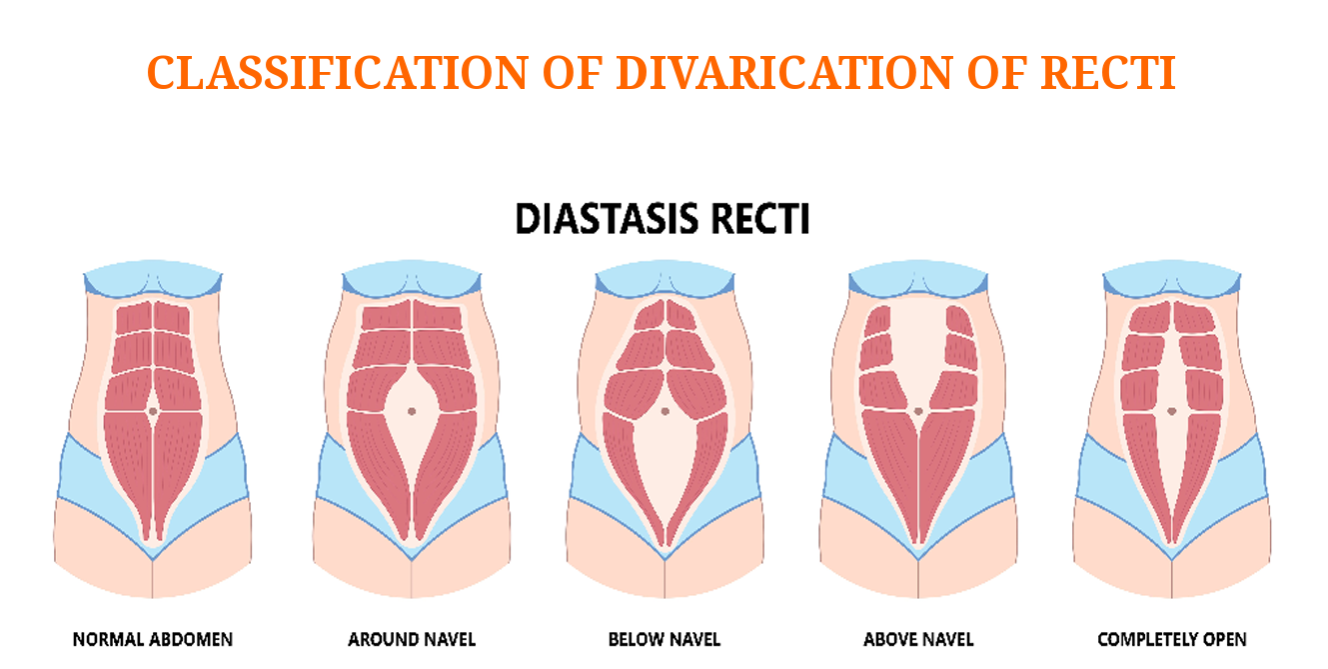
Diastasis Recti Classification Diagram
Clinical Insight: When the separation is wide (typically > 2 cm), the core loses its central anchor, predisposing the midline to umbilical or epigastric hernias.
Indicators

Recognizing the Symptoms

Separation of muscles compromises the structural stability of the trunk, causing several functional symptoms.

Midline Bulge

A vertical ridge or dome that rises when coughing, laughing, or sitting up from a lying position.

Lower Back Pain

Loss of abdominal support forces back muscles to overwork, causing chronic aches and poor posture.

Bloating & GI Issues

Decreased intra-abdominal support leads to poor bowel positioning and sluggish digestion.

Pelvic Floor Laxity

Often linked to weakness in pelvic floor dynamics, sometimes manifesting as urinary stress incontinence.

Therapeutic Progression

How We Treat Diastasis Recti

From conservative muscle rehab to advanced minimally invasive reconstruction options.

1. Targeted Core Physiotherapy

Initial management for mild separations or early postpartum recovery consists of deep core muscular rehab (targeting the transversus abdominis muscle).

Important Warning:

Standard abdominal exercises like sit-ups, crunches, twisting, or heavy planking can increase intra-abdominal pressure and worsen the separation. Only perform structured exercises prescribed by a diastasis specialist.

2. Surgical Rectus Plication

For severe muscle separation accompanied by core weakness, hernias, or chronic back pain, surgical re-alignment is highly effective. The stretched linea alba is folded (plicated) and stitched closed to pull muscles back together.

SCOLA Technique: Subcutaneous Onlay Laparoscopic Approach. A keyhole method restoring midline muscles through tiny incisions, avoiding the abdominal cavity.
Robotic-Assisted Repair: Using robotic platforms for highly stable midline suturing and reconstruction, often while simultaneously repairing co-existing midline hernias.
Common Questions

Frequently Asked Questions

Key insights regarding muscle separation and recovery options.

Reclaim Your Core Strength & Stability

Consult Dr. Kumar in Chennai for a personalized evaluation of your abdominal separation. Get an accurate diagnostic check and review customized repair solutions.