An overview of uncommon hernia types — epigastric, supraumbilical, lumbar, spigelian, and diaphragmatic hernias. These rarer forms require specialist evaluation and tailored surgical repair.
While inguinal, umbilical, and incisional hernias account for the vast majority of abdominal wall hernias, several rarer types occur in specific anatomical sites and present unique diagnostic and surgical challenges.
Because these hernias are uncommon, they are frequently misdiagnosed or overlooked. Dr. Kumar has particular expertise in recognising and repairing these rare presentations, including epigastric, supraumbilical, lumbar, spigelian, and diaphragmatic hernias.
Rare hernias are often misdiagnosed as musculoskeletal pain or other conditions.
Each rare type occurs at a different site requiring a tailored surgical approach.
Delayed diagnosis increases the risk of incarceration, strangulation, or organ damage.
A general hernia repair technique may not be appropriate — specialist expertise is essential.
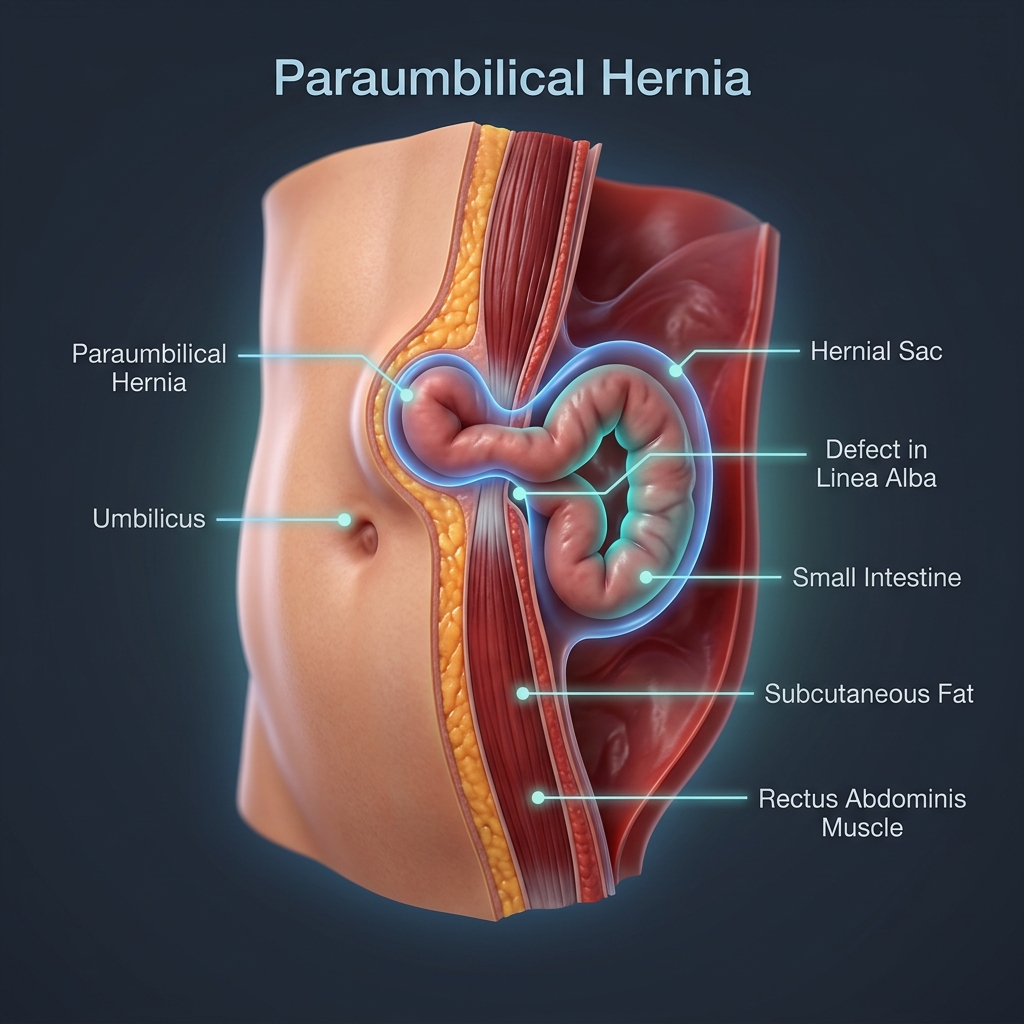
A concise guide to the rare hernia types Dr. Kumar diagnoses and repairs.
Develops in the upper midline between the belly button and the breastbone, where tissue pushes through the linea alba. Three times more common in men.
Occurs just above the umbilicus in the upper midline — sometimes classified as a variant of the epigastric hernia but typically closer to the navel.
A rare posterior abdominal wall hernia through the lumbar triangle (Grynfeltt or Petit). Can be congenital, acquired, or post-traumatic.
A rare lateral ventral hernia through the spigelian fascia — the line where the rectus muscle meets the lateral abdominal muscles. High incarceration risk.
A defect in the diaphragm allowing abdominal organs (stomach, bowel) to enter the chest cavity. Can be congenital, traumatic, or acquired.
While each rare hernia has its own features, several symptoms are shared across the group.
A small, often intermittent lump at the hernia site, sometimes only visible on standing or straining.
Aching or burning pain at the anatomical site, often worsening with exertion, lifting, or coughing.
Symptoms typically ease when lying down or resting, returning with activity — a classic hernia sign.
Direct tenderness or a palpable defect on examination, sometimes the only clue in small rare hernias.
Many rare hernias are discovered incidentally on CT or MRI performed for unrelated reasons.
Severe pain, vomiting, breathlessness, or non-reducible bulge requires immediate medical attention.
Book an appointment with Dr. Kumar for an accurate diagnosis and a tailored surgical plan for any uncommon hernia presentation.
+91 89255 02759
Tap to call
Dr. Kumar specializes in advanced minimally invasive techniques. Laparoscopic and Robotic approaches are preferred for faster recovery, less pain, and tiny scars. Open repair is reserved for select cases.
Minimally Invasive · Keyhole Surgery
For most rare hernias (Spigelian, lumbar, supraumbilical, obturator), Dr. Kumar's preferred approach is laparoscopic — typically TEP or TAPP. Keyhole access allows inspection of the entire abdominal wall, detecting occult defects that single-incision open surgery would miss, with wide mesh overlap for a durable repair.
Latest Technology · 3D Vision
State-of-the-art advanced robotic platform for unmatched precision, 3D visualization, and wristed instruments — ideal for complex or large rare hernias that benefit from component separation, TAR, or full Abdominal Wall Reconstruction (AWR).
Time-tested open technique (mesh repair) reserved for select cases — large, infected, contaminated, or emergency hernias, and patients unsuitable for keyhole surgery.