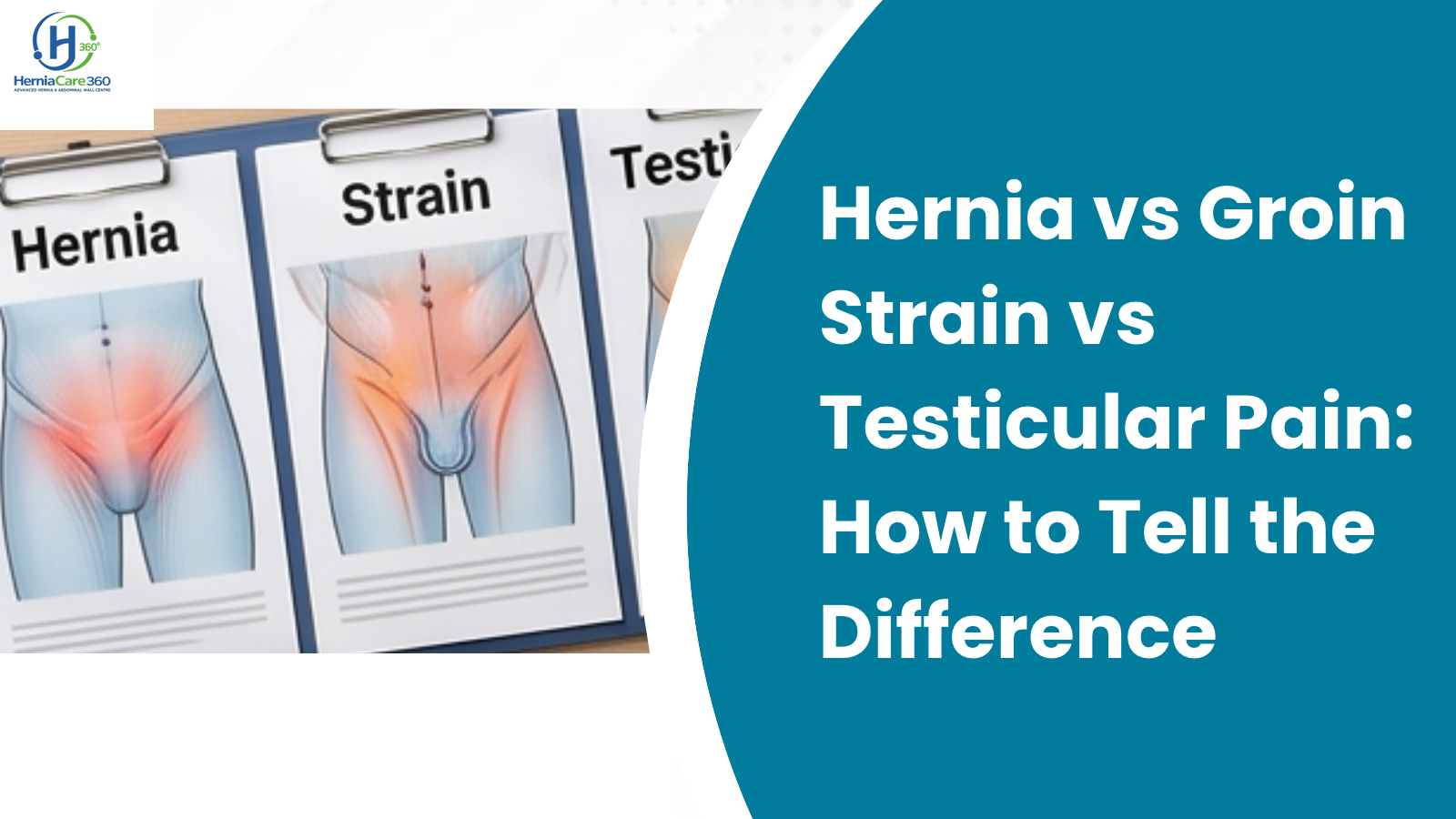
A hernia usually brings a groin bulge that grows over weeks and does not heal. A strain starts with a clear injury and improves over days to weeks. Sudden, severe testicular pain is different: it can be torsion, an emergency needing care within hours.
Why These Three Get Confused
Pain in the groin or just above the testicle has many causes, and the three most common culprits for men are a hernia, a groin strain, and a problem inside the scrotum. Harvard Health puts it bluntly: for a strain versus a hernia, "there's very little difference in symptoms." Both can cause a dull ache, burning or heaviness, especially when standing. That is why guessing from pain alone often goes wrong, and why the clues below are about timing, lumps and triggers rather than how much it hurts.
One point matters more than everything else here: sudden, severe testicular pain is an emergency, not something to compare against a table. We cover that first so you do not lose time.
Sudden Testicular Pain Is Never a Wait-and-See Problem
Go to an emergency department right away if you have
- Sudden, severe pain in one testicle, especially with nausea or vomiting
- A testicle that looks higher than usual, or a swollen, tender scrotum that came on quickly
- Pain that is severe and not easing within an hour
These can point to testicular torsion, where the testicle twists and its blood supply is cut off. NHS-affiliated guidance stresses going straight to A&E and not waiting to see if the pain improves. The time window is short: NHS sources describe a good chance of saving the testicle when it is treated within about six hours, and some clinical guidance aims for surgery sooner. The safe rule is simply that earlier is better. Do not take a painkiller and wait for morning.
Hernia vs Groin Strain vs Testicular Pain at a Glance
| Inguinal hernia | Groin strain | Testicular or scrotal problem | |
|---|---|---|---|
| How it starts | Often gradual, over weeks or months. Some men notice it after a lift or cough. | A clear moment: a sprint, kick or sudden twist, sometimes with a pop. | Torsion is sudden and severe. Infection or inflammation tends to build, with tenderness. |
| A lump | Often yes, a bulge in the groin that may reach the scrotum. | Usually no lump. | Swelling of the scrotum or testicle itself. |
| Gets worse with | Standing, coughing, lifting, straining. | Moving the leg: kicking, sprinting, squeezing the thighs. | Touch, or movement, depending on the cause. |
| Effect of lying down | Lump often shrinks or vanishes. | Little change, rest helps over days. | Little change. |
| Course over time | Does not heal on its own and can grow. | Improves over days to weeks. | Depends on cause. Torsion needs surgery urgently. |
| Who to see | A hernia surgeon or doctor, soon. | A doctor, if not improving. | Urgent care if sudden. Otherwise a doctor promptly. |
Table sources: Harvard Health on strain versus hernia, NIDDK on inguinal hernia, and NHS-affiliated guidance on testicular torsion. It describes typical patterns only. Real symptoms overlap, and a man can have more than one problem at once.
Five Questions That Point You in a Direction
- Was there a moment? A definite sprint, kick or twist followed by pain suggests a muscle or tendon strain. Harvard Health describes a strain as often starting with a noticeable moment of injury, sometimes a popping feeling.
- Can you see or feel a lump? A bulge in the groin is the hallmark of a hernia. A strain typically does not produce one.
- Does the lump change when you lie down? A groin bulge that shrinks when flat fits a reducible hernia. The hernia symptoms page lists the other signs.
- Is it getting better by itself? A strain should improve over days to weeks. A hernia hole does not heal on its own, although the pain can come and go.
- Is the pain in the testicle, or above it? Pain that is truly in the testicle, or with scrotal swelling, needs a prompt exam, because a groin hernia can also reach the scrotum.
The Hernia Look-Alike Called a Sports Hernia
Athletes in Chennai's cricket grounds, football turfs and gyms may hear the term "sports hernia". Harvard Health points out that this is a misleading name, since it describes a muscle injury in the groin rather than a true hernia with a bulge. If your groin pain began during sport and you have no lump, this may be the category. Our page on sports hernia explains how it is assessed. A true inguinal hernia, by contrast, is a gap in the muscle wall and needs a different plan.
What the Doctor Does to Sort It Out
The examination is simple and quick. The doctor takes a history, looks and feels the groin while you stand, and asks you to cough or strain so that a bulge can show itself. If the picture is unclear, NIDDK notes that ultrasound, CT or MRI may be used. Our hernia diagnosis page describes the full process. For the detailed list of signs that suggest a hernia in particular, see inguinal hernia symptoms in men.
A note on self-treating
If you have a groin lump, do not treat it as a strain. Rest, ice and anti-inflammatory tablets suit a muscle strain. They do nothing for a hernia, and months of "resting" a hernia only delay the right treatment.
If an examination confirms an inguinal hernia, treatment options are laid out on the inguinal hernia treatment in Chennai page. If it is a strain or a scrotal condition, you will be told that too, and directed to the right care.
Frequently Asked Questions
Q1: Can a hernia feel like a pulled groin muscle?
Yes. Harvard Health notes the symptoms overlap heavily, with dull ache, burning or heaviness. A visible lump points toward a hernia, but only an examination can tell for certain.
Q2: How long should a groin strain take to improve?
A strain usually eases over days to weeks. Pain that is not improving, keeps returning, or comes with any groin lump should be examined rather than rested indefinitely.
Q3: Can an inguinal hernia cause testicle pain?
It can. A hernia that extends into the scrotum may cause swelling, heaviness or discomfort near the testicle. Any new scrotal swelling or pain should be checked promptly.
Q4: Is sudden testicular pain an emergency?
Yes. Sudden, severe pain in one testicle can be torsion, where blood supply is cut off. Go to an emergency department immediately and do not wait to see if it eases.
Q5: Will an ultrasound show whether it is a hernia?
Often, when an examination is unclear. NIDDK lists ultrasound, CT and MRI as options. Many hernias are diagnosed by examination alone, standing and coughing, without any scan.
Q6: Is a sports hernia a real hernia?
Not in the usual sense. Harvard Health calls the name misleading because it is a muscle injury in the groin, not a gap in the abdominal wall with a bulge.
This article is general medical information, not a diagnosis. Groin and testicular pain has many causes, and anyone with sudden severe pain should seek emergency care instead of reading further.
Not Sure What Your Groin Pain Is?
Book a consultation for a proper examination. Dr. Kumar can tell you whether a hernia is involved and what to do next.
Book a Groin Pain Consultation